 Scientific Bulletin – Automotive Series
Scientific Bulletin – Automotive Series
Scientific Bulletin – Automotive Series
Year XXXII, Volume 36

Abdülvahap ÇAKMAK, Asıf VAROL
Abstract:Biodiesel, an alternative to fossil diesel fuel, has low oxidation stability due to the presence of unsaturated fatty acid methyl esters (FAMEs) in its composition. Oxidation of biodiesel reduces fuel quality, shortens storage life, and causes pollution and clogging in the engine fuel system. Adding synthetic antioxidants to biodiesel improves its oxidation stability. However, because synthetic antioxidants are petroleum-based products with toxic and environmental impacts, sustainable natural antioxidant additives are needed to improve the oxidation stability of biodiesel. Natural plant and other-source antioxidants offer an environmentally friendly, sustainable approach to enhancing the oxidative stability of biodiesel. This study investigated the effect of sage essential oil (SEO), rich in phenols, on the oxidation stability of biodiesel. In this study, 2500 ppm of SEO was added to biodiesel fuel for analysis. To measure the effectiveness of sage oil, a natural resource, comparative tests were conducted with samples containing the same concentration of the synthetic commercial antioxidant butylated hydroxytoluene (BHT). During the process, the chemical structures of fuels with and without the antioxidant were analyzed using spectroscopic and thermal analysis methods. Furthermore, the changes in the basic thermophysical fuel properties resulting from the antioxidant addition were determined. The data obtained revealed the potential of SEO to improve the oxidative resistance of biodiesel.
Keywords:Antioxidant, Biodiesel, Fuel properties, Oxidation, Sage essential oil
Andreea TINTATU
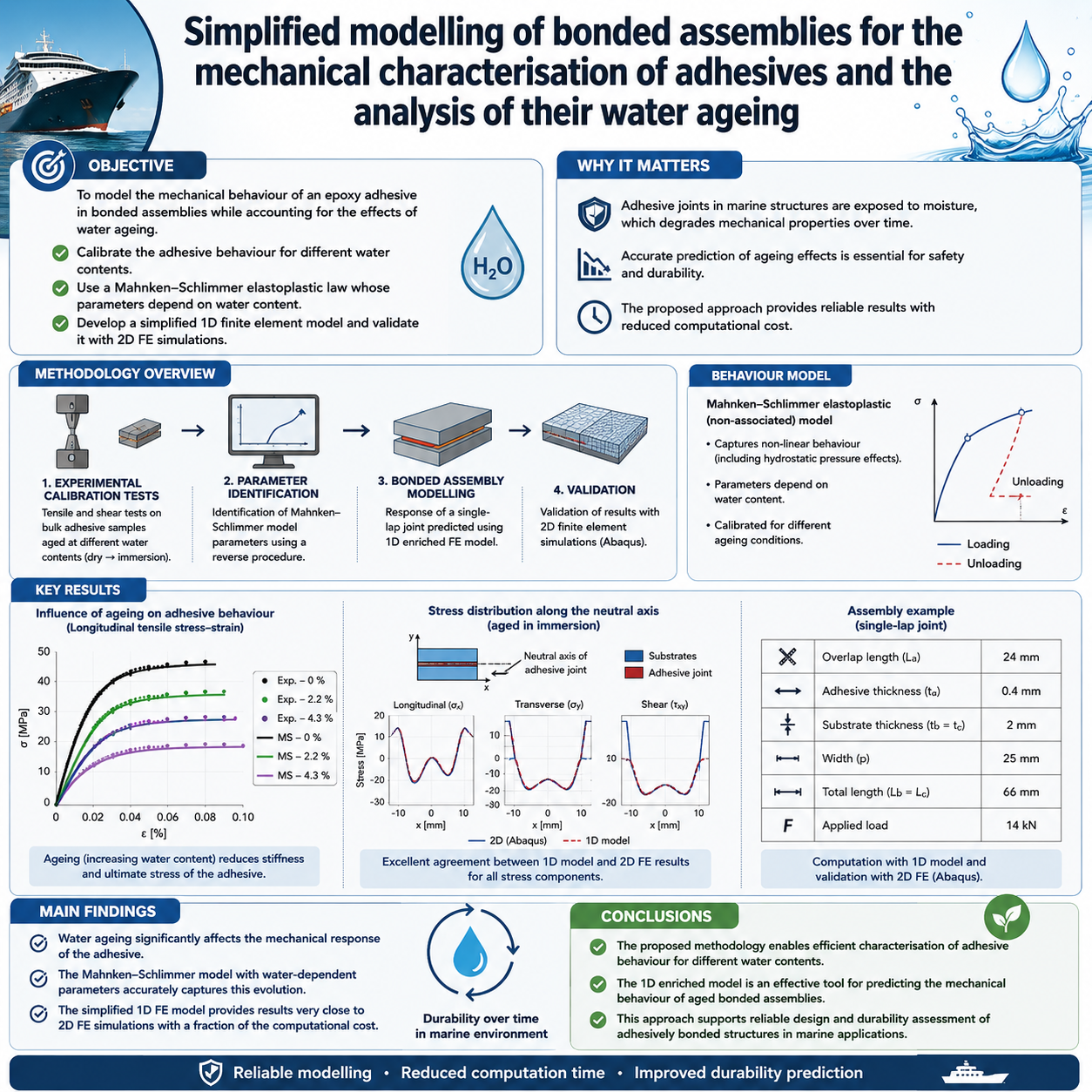
Abstract:The ageing of adhesives is of major interest to the marine industry because the mechanical properties of these materials change with long-term exposure to moisture. The aim of this paper is to model the mechanical behaviour of such adhesives in bonded assemblies, taking into account the effects of water ageing. Based on experimental tests, the behaviour of a chosen adhesive is calibrated for different levels of water absorption. An elastoplastic behaviour law of the Mahnken-Schlimmer type is used to describe the non-linear behaviour of the adhesive. The material parameters depend on the water content. In this study, an enriched 1D finite element model is developed, allowing an accurate description of all the deformation and stress states, particularly within the adhesive joint. Numerical simulations using 2D finite elements are also carried out for validation purposes.
Keywords:Bonded assemblies, water ageing, mechanical characterisation, finite element simulation.
Andrei MATAR, Adrian CLENCI
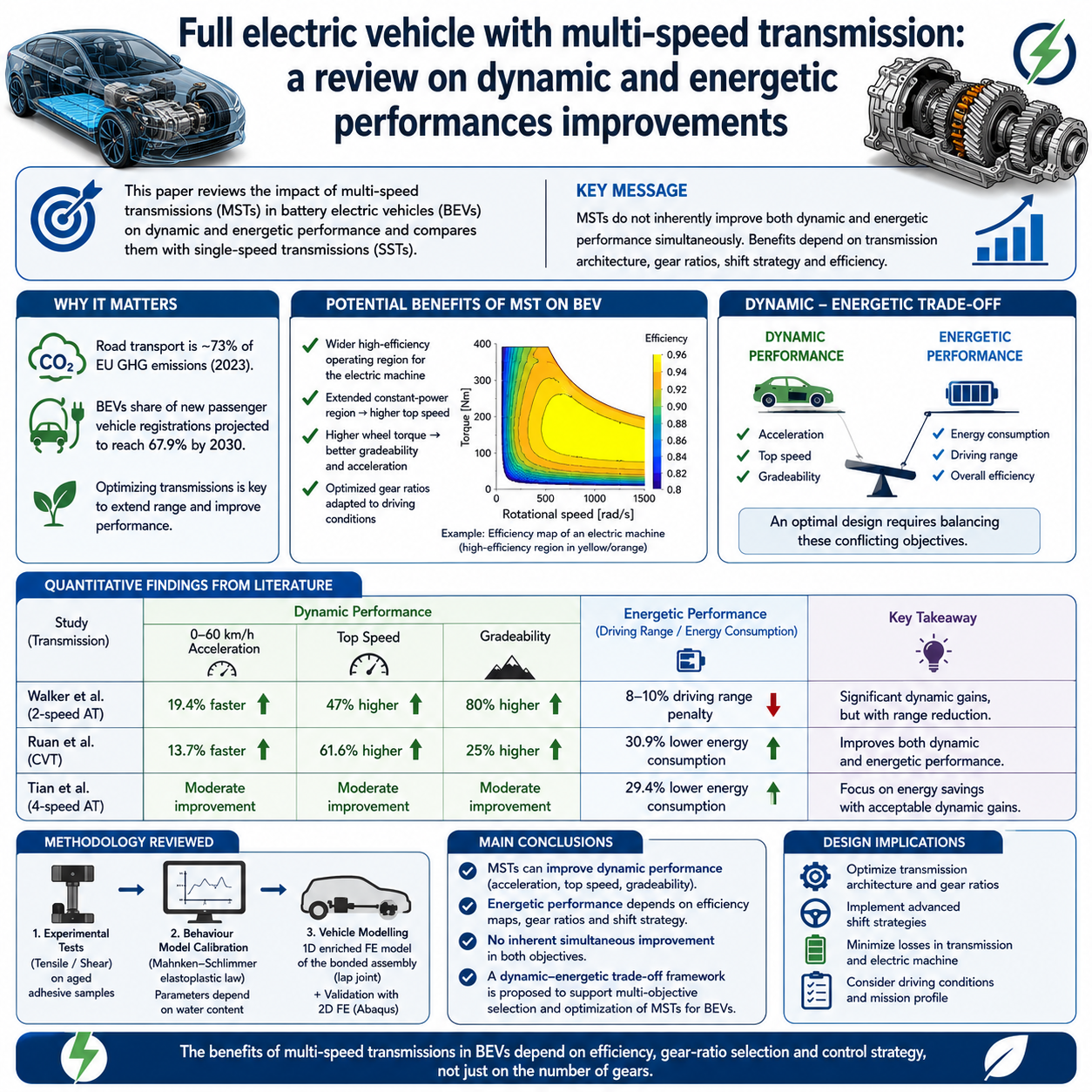
Abstract:Multi-speed transmissions (MSTs) can improve the dynamic and energetic performance of battery electric vehicles (BEVs), but their benefits depend on transmission architecture, gear ratios, shift strategy and losses.This paper presents a comprehensive literature review and quantitative database of published BEV MST studies, comparing dynamic and energetic performance with single-speed transmissions (SSTs). The results show that MSTs do not inherently provide simultaneous improvements.Walker et al. reported 19.4% faster 0–60 km/h acceleration, 47% higher top speed and 80% higher gradeability, but an 8–10% driving-range penalty. Conversely, Ruan et al. achieved 13.7% faster 0–60 km/h acceleration, 61.6% higher top speed, 25% higher gradeability and 30.9% lower energy consumption using a CVT. Tian et al. reported a 29.4% reduction in energy consumption with a 4-speed transmission and moderate dynamic improvements. The results highlight the importance of transmission efficiency, gear-ratio selection and shift strategy, rather than the number of ratios alone. A dynamic–energetic trade-off framework is proposed to support the multi-objective selection and optimization of MST configurations for BEVs.
Keywords:Battery electric vehicle; multi-speed transmission; dynamic performance; energetic performance; dynamic–energetic trade-off